Print Recipe
These Banana Oat Muffins are mixed in one bowl, so prep and cleanup couldn’t be easier. They’re made with simple ingredients, including whole wheat flour and oats for added fiber and hearty texture. With naturally sweet, overripe bananas, a bit of cinnamon, and a splash of vanilla, these healthier (and every bit as delicious) muffins are filled with comforting flavors the entire family will love.

This is the quintessential muffin recipe for busy people. Simple ingredients, even simpler preparation. Just mix together the ingredients in one bowl, and bake.
They might not teach this “one bowl” method in culinary school (most pros recommend mixing the wet and dry ingredients in separate bowls to limit gluten production), but this simplified method gets the job done. The muffins come out delicious, and cleanup is easy.
It’s the type of shortcut I make all of the time as a busy mom feeding my family in real life. There’s no need to overcomplicate things!
For breakfast, I recommend pairing these banana oat muffins with a higher-protein option, like a hard boiled egg, Greek yogurt, a veggie frittata, or white bean and avocado toast. They make a tasty, grab-and-go snack, too. Try spreading butter or your favorite nut butter on top for a little extra staying power!
Jump to:
- Ingredients
- Instructions
- Substitutions
- Variations
- Equipment
- Storage
- Top tip
- FAQ
- Pairing
- Related
 Recipe
Ingredients
These banana muffins are made with simple ingredients that are probably in your kitchen already. It’s the type of recipe you can make whenever the mood strikes, without an extra trip to the store.
Mixing whole wheat flour and oats into the batter gives these muffins a some extra fiber, which makes them more hearty and filling. Fats from the olive oil and whole milk provide rich flavor and a tender crumb.
Sweet, overripe bananas, cinnamon, and vanilla bring on the flavor.

Grocery list:
- Bananas (look for ripe bananas in the discounted produce section.)
- Egg
- Whole milk
- Sugar
- Olive oil
- Vanilla extract
- All purpose flour
- Whole wheat flour
- Oats
- Baking powder
- Ground cinnamon
- Salt
Optional add-ins:
- chopped nuts (such as walnuts or pecans) or chocolate chips
See the recipe card at the end of this post for ingredient quantities.
Instructions
Here’s a basic summary of how to make these one-bowl muffins.

Mash the banana and egg together. Add the other wet ingredients and mix.

Pour the dry ingredients on top and then stir the batter until just mixed.

Transfer the batter to a muffin pan and bake.

Cool on a wire rack.
Hint: Make sure your baking powder is fresh! Once opened, baking powder should be used within three months. Using expired baking powder will lead to muffins that don’t rise.
Substitutions
A few suggestions for ingredient swaps:
- Dairy free: Substitute unsweetened dairy-free milk alternative for whole milk.
- Vegan: Use dairy-free milk alternative instead of whole milk and substitute a flax egg for the egg.
- Gluten free: use 2 ½ cups 1:1 gluten-free flour instead of the all purpose flour and whole wheat flour.
- 100% whole grain: Use 2 ½ cups whole wheat flour and omit the all purpose flour. The texture will be denser and heartier.
- Oil: Substitute another liquid vegetable oil, such as grapeseed oil or avocado oil, or use melted butter instead of olive oil.
Variations
Make it your own:
- Nuts: fold ½ cup chopped walnuts or pecans into the batter.
- Chocolate chips: fold in ½ cup chocolate chips.
Try my Double Chocolate Pumpkin Muffins for another option!

Equipment
- Muffin pan: Use a standard, 12-cup muffin tin.
- Muffin liners: Paper or reusable silicone liners work well. If you don’t have liners, be sure to grease the muffin tin with oil or melted butter before adding the batter.
- Large mixing bowl: to mix the batter
- Oven: for baking the muffins.
- Wire cooling rack: Place the baked muffins on a wire rack to cool. If you don’t have a rack, take the muffins out of the pan after five minutes and cool directly on the counter instead.
Storage
Muffins are a great breakfast/snack option to prep ahead of time. When making ahead, be sure to allow the muffins to cool completely. Then store them in an airtight container at room temperature for up to four days.
Muffins can also be stored in a freezer bag and frozen for up to three months. Thaw frozen muffins completely at room temperature or microwave from frozen for about 30 seconds per muffin.

Top tip
Don’t over-mix the muffin batter! Over-mixed batter will lead to muffins that are tough. Stir just until the dry flour is no longer visible.
FAQ
Bananas should be covered in brown (or even black) spots and have a strong aroma to be used in baking recipes, like muffins. Overripe bananas give muffins more flavor.
Whole milk is a great option for muffins, because it has a higher fat content. This fat gives muffins rich flavor and tender crumb.
Pairing
These are my favorite things to have with banana muffins:
-
Vanilla Matcha Latte
-
Mushroom Goat Cheese Frittata
-
Berry Coconut Water Smoothie
-
Sweet Potato Breakfast Bowl


Related
Looking for more healthy breakfast recipes? Try these:
-
Double Chocolate Muffins with Pumpkin and Chocolate Chips
-
Easy No-Bake Homemade Energy Bars with Oats
-
Overnight Mango Banana Chia Pudding with Coconut Milk
-
Yogurt Toast with 3 Topping Ideas


Recipe

One-Bowl Banana Oat Muffins
Pin
Save Saved!
Rate
Equipment
-
Muffin pan
-
Muffin liners optional
-
Large mixing bowl
-
Oven
-
Wire cooling rack optional
Ingredients
- 3 large overripe bananas
- 1 egg
- ¾ cup whole milk
- ½ cup sugar
- ¼ cup olive oil
- 1 teaspoon vanilla extract
- 1 ¼ cup all purpose flour
- 1 ¼ cup whole wheat flour
- ½ cup oats
- 2 teaspoons baking powder
- 1 teaspoon ground cinnamon
- 1 teaspoon salt
Optional add-ins:
- ½ cup chopped nuts such as walnuts or pecans or chocolate chips
Instructions
-
Preheat oven to 375 degrees Fahrenheit and line a muffin pan with liners. (If you aren’t using liners, lightly grease the muffin pan instead.)
-
Mash bananas and egg in a large bowl until uniform (it’s okay if there are still lumps). Add milk, sugar, oil, and vanilla and stir until combined. Add all purpose flour, whole wheat flour, oats, baking powder, cinnamon, and salt, and stir until just combined. Do not over-mix. Fold in nuts or chocolate chips if using.
-
Pour batter into muffin pan, filling each cup about ⅞ full. Transfer to the oven and bake 22 minutes, or until an inserted toothpick comes out clean. Allow to cool in the pan for 5 minutes, and then transfer muffins to a wire cooling rack to cool completely.
Notes
- Storage and making ahead: Allow muffins to cool completely and store in an airtight container at room temperature for up to 4 days.
- Freezing: Store in a freezer bag for up to 3 months. Thaw frozen muffins completely at room temperature or microwave from frozen for about 30 seconds per muffin.
- Dairy free: Substitute unsweetened dairy-free milk alternative for whole milk.
- Vegan: Use dairy-free milk alternative instead of whole milk and substitute a flax egg for the egg.
- Gluten free: use 2 ½ cups 1:1 gluten-free flour instead of the all purpose flour and whole wheat flour.
- 100% whole grain: Use 2 ½ cups whole wheat flour and omit the all purpose flour. The texture will be denser and heartier.
- Nutrition facts are estimates only and do not include optional add-ins.
- This recipe was originally published in 2018 and has been updated.
Nutrition
These one-bowl Double Chocolate Muffins with pumpkin and chocolate chips are sweet (but not too sweet!). You’d never guess they have fruit and veggies inside. They’re really easy to make, because you mix everything together in just one bowl. Muffins are a simple and delicious make-ahead breakfast, snack, or even dessert. Because this recipe has an extra healthy boost from pumpkin and applesauce, it’s great for any chocolate-lover who want to squeeze in extra fruits and vegetables throughout the day!

The magic of these muffins is that they incorporate nutrient-dense pumpkin and naturally sweet applesauce. So they’re infused with a touch of nutrition while still maintaining all of their chocolatey, decadent appeal.
This recipe is great if you want to bake with pumpkin, but don’t want over-the-top pumpkin flavor. Chocolate really is the star of this show!
The combination of cocoa powder and chocolate chips (what makes these “double” chocolate!) creates a rich, deep chocolate flavor. It’s just so indulgent, and so, so good.
For the finishing touch, add a few extra chocolate chips and a little sprinkle of sugar on top of the muffins before they go in the oven. This small detail creates a beautiful, delicate crust that adds an extra layer of texture and sweetness. It’s just one more way these muffins taste sweet without a ton of sugar on the inside.
Oh and one last perk I should mention just in case you weren’t sold on baking these muffins ASAP. You can mix the entire batter in just one mixing bowl.
Chocolate muffin bliss minus the extra cleanup. Are you ready for it?
Jump to:
- Ingredients
- Instructions
- Substitutions
- Variations
- Equipment
- Storage
- Top tip
- FAQ
- Related
- Pairing
- Recipe
Ingredients
Pumpkin and applesauce are two healthier ingredient swaps that make this muffin recipe special.
Canned pumpkin puree is packed with beta-carotene, which our bodies convert into vitamin A, and it also contains vitamin C, potassium, and fiber. Beyond these nutritional benefits, baking with pumpkin means you don’t need as much fat (like oil and butter) to get delicious muffins that aren’t dried out.
Swapping in a bit of unsweetened applesauce offers similar benefits. Again, you don’t need as much fat, plus applesauce lends natural sweetness to these muffins, so you don’t have to go overboard with the sugar, either.

Here’s a full list of the ingredients you’ll need:
- pumpkin puree – make sure it’s unsweetened pumpkin puree and not pumpkin pie filling. You could also cook pumpkin or squash and puree it yourself.
- eggs
- granulated sugar
- olive oil – regular olive oil (not extra virgin) will have a lighter flavor that works well for baking
- unsweetened applesauce
- maple syrup
- vanilla extract
- all purpose flour
- unsweetened cocoa powder
- baking powder
- baking soda
- salt
- chocolate chips – use regular, dairy-free, dark chocolate, or no-added-sugar, depending on what you’re looking for!
See the recipe card below for exact quantities and preparation details.
Instructions
This is a basic run-down of the steps for making chocolate muffins. You can find more detailed instructions in the recipe card at the bottom of this post.

Combine the wet ingredients.

Stir in the dry ingredients.

Fold in the chocolate chips.

Divide the batter between muffin cups and top with additional chocolate chips and sugar if desired.

Bake at 425º F for 8 minutes, then reduce oven heat to 350ºF and bake for an additional 20 minutes, or until an inserted toothpick comes out clean.
Hint: Greasing the muffin liners will make it easy to remove the muffins after baking. I like to spray the inside of the liners with a neutral oil. Here’s an affiliate link for the oil mister that I have and love.
Substitutions
You can easily tweak this recipe to fit a variety of dietary needs. Here are a few ideas.
- Dairy-free – Use dairy-free chocolate chips
- Lower sugar – Use dark chocolate chips or no-sugar-added chocolate chips
- Vegan or egg-free – Substitute flax eggs for the eggs and use dairy-free chocolate chips
- Gluten-free – Substitute 1:1 gluten-free flour and make sure your chocolate chips are gluten-free
- Oil – Use another neutral oil in this recipe (such as grapeseed or canola) if desired. You could also swap in melted coconut oil if you don’t mind the coconut flavor.

Variations
Want to make this recipe your own? Here are a few more ideas for flavor variations.
- Pumpkin Chocolate Chip Muffins – omit the cocoa powder and add ground cinnamon or pumpkin pie spice
- Chocolate Nut Muffins – Substitute chopped walnuts for the chocolate chips
- Zucchini Chocolate Muffins – Use shredded zucchini instead of pumpkin puree
Equipment
First, you’ll need a large mixing bowl to mix the batter. Use a whisk to combine the wet ingredients, and a large mixing spoon or spatula for stirring the dry ingredients.
If you don’t have a whisk, you can use a fork instead.
To bake the muffins, you need a standard 12-cup muffin tin and muffin liners. I tested these muffins both with and without liners, and they’re so much easier to remove from the tin if you use the liners.
If you don’t have muffin liners, you can cut pieces of parchment paper to fit into the muffin cups instead.
You can also bake these in an unlined muffin tin in a pinch, but you will definitely want to grease the cups with oil first if you take this route!
Storage
Make sure the muffins are completely cooled before you store them.
If you plan to eat them within a few days, you can leave them on the counter at room temperature. Line an airtight container with a paper towel and store the muffins in a single layer in the container. They can be left out at room temperature for up to five days.
If you want to keep these longer than five days, I recommend freezing them. Store the cooled muffins in a freezer-safe bag and freeze for up to three months.
Thaw muffins at room temperature or in the microwave.
Top tip
Don’t over-mix the muffin batter! Mixing too much will lead to denser, less fluffy texture. Stir just until you don’t see streaks of dry flour.
FAQ
A chocolate muffin can absolutely be part of a balanced breakfast. If you notice that you don’t feel full after eating just a muffin, add an egg or small bowl of Greek yogurt for extra satisfying protein.
Chocolate muffins are a great make-ahead breakfast, snack, or dessert recipe. You can store leftovers at room temperature or freeze them for up to three months.
Top chocolate muffins with chocolate chips, granulated sugar, chopped nuts, or sprinkles. You could also add frosting or icing for more of a dessert feel.
Related
Looking for more healthy-ish baked treats? Try these:
- Whole Wheat Lemon Blueberry Muffins
- Gluten-Free Golden Milk Muffins
- Banana Pecan Oat Muffins


Pairing
These are my favorite recipes to serve with chocolate muffins:
- Mushroom Goat Cheese Frittata
- Spiced Oat Milk Latte
- Honey Turmeric Yogurt Bowl
- Vanilla Matcha Latte


Recipe

Double Chocolate Muffins with Pumpkin and Chocolate Chips
Equipment
- Mixing bowl, whisk, spoon
- Muffin tin and liners
Ingredients
- 1 ½ cups pumpkin puree
- 4 eggs
- ½ cup granulated sugar
- ½ cup olive oil
- ½ cup unsweetened applesauce
- ¼ cup maple syrup
- 2 teaspoons vanilla extract
- 2 cups all purpose flour
- ½ cup unsweetened cocoa powder
- 1 ½ teaspoons baking powder
- 1 ½ teaspoons baking soda
- ½ teaspoon salt
- 1 cup chocolate chips (use dairy-free, dark chocolate, or no-sugar-added if desired)
Optional for Toppings:
- ¼ cup chocolate chips (use dairy-free, dark chocolate, or no-sugar-added if desired)
- 2 teaspoons granulated sugar
Instructions
- Preheat the oven to 425 degrees Fahrenheit and line and grease a muffin tin.
- Whisk pumpkin puree, eggs, sugar, olive oil, applesauce, maple syrup, and vanilla in a large bowl until evenly mixed.
- Add flour, cocoa powder, baking powder, baking soda, and salt and stir until just combined. (Stop stirring as soon as you don’t see any visible dry flour.)
- Fold in ¾ cup chocolate chips.
- Divide batter evenly between muffin cups. Add optional toppings of chocolate chips and sugar (if desired).
- Bake on the center rack for 8 minutes, then, leaving the muffins in the oven, reduce the heat to 350 degrees Fahrenheit and bake for an additional 20 minutes, or until an inserted toothpick comes out clean.
- Remove from the oven and let muffins rest in the pan for 5 minutes before transferring to a wire rack to cool completely.
Notes
Nutrition
Print Recipe
With a simple mix of dates, nuts, oats, peanut butter, and chocolate chips, these no-bake homemade energy bars are a delicious healthy snack to keep stocked in your kitchen at all times. This is a simple DIY recipe that’s great for everyday snacking. It’s both adult- and kid-approved!

I know I’m not the only one who’s waited a little too long to eat and ended up hangry and ravenous, grabbing any and all of the snacks to quell the hunger pangs.
Keeping a few filling and satisfying bites on hand is the best way to prevent yourself from sinking into this sad starvation mode.
Ideally, you want an easy-to-grab snack with a balanced mix of nutrients that will help you feel energized and satisfied until your next meal. Homemade energy bars are a fantastic option.
These Chocolate Peanut Butter Bars have carbohydrates from the dates and oats, and a mix of protein and fat from the peanut butter and almonds. This balance is key for feeling full and energized.
They’re deliciously chewy and a little crunchy, plus there’s chocolate, which makes them SO satisfying.
This recipe is perfect for a quick everyday snack and also a great option for endurance athletes, like runners and cycling aficionados. The chocolate + peanut butter combo makes these bars perfect for kids, too!
If you’re looking for more plant-based snack ideas, try my Cheesy Roasted Chickpeas, Spicy Tofu Jerky, or Berry Coconut Water Smoothie. Along with energy bars, these recipes are some of my favorites to reach for whenever between-meal hunger rears its head.
Jump to:
- Ingredients
- Instructions
- Substitutions
- Variations
- Equipment
- Storage
- Top tip
- Frequently Asked Questions (FAQ)
- Recipe
Ingredients
One of the best things about this recipe is that you only need a few basic pantry ingredients. They are:

- Dates – For the best flavor, I prefer to use whole dates and remove the pits and chop myself.
- Almonds – I like raw (not roasted) almonds for this recipe.
- Oats – Look for dry rolled oats that cook in one minute. They may be labeled as Quick Oats or Instant Oats. Use certified gluten-free oats if needed.
- Peanut butter – I use creamy peanut butter with no added sugar. Salted and unsalted peanut butter both work, depending on your poreference.
- Chocolate chips (optional) – I use Ghirardelli 60% Cacao Bittersweet Chocolate Chips for this recipe.
- Cinnamon (optional)
See the recipe card at the end of this post for exact quantities and preparation instructions.
Instructions
Here’s a basic summary of how to make energy bars at home. You can find more detailed instructions in the recipe card at the end of this post.

Add all of the ingredients except the chocolate chips to a food processor. Process until the mixture sticks together when pressed.

Add the chocolate chips and pulse until they’re evenly mixed with the other ingredients.

Transfer the mixture to a parchment-lined 8×8-inch baking pan and press down firmly and evenly with your hands. Chill in the freezer for at least 2 hours.

Remove from the freezer, transfer to a cutting board, and cut into pieces.
Hint: Lining the baking pan with parchment paper makes it easier to remove the bars from the pan later.

Substitutions
You can easily make these homemade energy bars fit a variety of dietary needs. Here are a few possible substitutions.
- Vegan/Dairy-Free – use dairy-free chocolate chips (such as Lily’s) or skip them completely.
- No Added Sugar – omit or use stevia-sweetened chocolate chips (such as Lily’s). Use peanut butter with no added sugar.
- Peanut-Free – substitute almond butter or cashew butter (or any nut/seed butter) for the peanut butter.
This recipe is naturally gluten-free. Just make sure the oats and other packaged ingredients are labeled gluten-free if needed.
Variations
I love the peanut butter chocolate chip flavor of these bars, but you can also change up the ingredients with a few simple swaps. Here are a few ideas.
- Cinnamon Raisin – double the cinnamon and use raisins instead of chocolate chips
- White Chocolate Macadamia – Use macadamia nuts instead of almonds and white chocolate chips instead of regular chocolate chips.
- Cashew – substitute cashews for almonds and use cashew butter instead of peanut butter.
- Tahini – use tahini instead of peanut butter.
There are so many possibilities for flavoring homemade energy bars. Try my Homemade Sweet Potato Energy Bars recipe if you’re looking for a new way to eat more veggies!
Equipment
You’ll need a food processor to make these energy bars at home. I use an 8-cup food processor, but a smaller one could also work.
To make energy bars without a food processor, just finely chop the ingredients, mix them together in a large bowl, and then transfer the mixture to a baking pan. Follow the rest of the recipe as written.
Use an 8-inch square baking pan to act as the mold for forming the bars. I like to line the pan with parchment paper so it’s easy to remove the mixture from the pan after they are chilled in the freezer.

Storage
Store in an airtight container in the refrigerator for up to five days or in a freezer-safe, airtight container for up to three months.
I prefer to store these bars in the freezer because they hold their shape better. I usually thaw one for about 5-10 minutes on the counter before eating.
Because these bars aren’t baked, they’re not great for traveling or eating on-the-go. You’ll need to keep them in the fridge or freezer to prevent them from falling apart.
Top tip
Spend a few minutes pressing the mixture firmly and evenly into the baking pan with the heels of your hands. Don’t rush through this step! It’s essential for making the bars stick together.
Frequently Asked Questions (FAQ)
Energy bars have a mix of macronutrients (carbohydrates, protein, and fat) that provide both quick and long-lasting energy. They’re a balanced snack to try when you want to feel more energized.
Energy bars often contain a mix of nuts, nut butter, dates, and sometimes grains like oats. Some also contain flavorings like dried fruit, chocolate chips or cinnamon.
To make homemade energy bars that stick together, you first need the right balance of dry and wet ingredients. Try adding more dates or nut butter if the mixture isn’t sticking together after processing. You also need to firmly press the energy bar mixture into the pan with your hands. Finally, be sure to chill the bars in the freezer for the best results.
Recipe

Easy No-Bake Homemade Energy Bars with Oats
Pin
Save Saved!
Rate
Equipment
-
Knife and cutting board
-
Food processor
-
8-inch square baking pan
-
Parchment paper
Ingredients
- 1 ½ cup chopped pitted dates (about 18 medjool dates, see note)
- 1 cup almonds
- ¾ cup quick-cook oats (dry, see note)
- ¾ cup peanut butter (or almond butter)
- 1 teaspoon ground cinnamon (optional)
- ½ teaspoon salt (optional)
- ½ cup chocolate chips (optional, see note)
Instructions
-
Line an 8-inch square baking pan with parchment paper and set aside.
-
Add dates, almonds, oats, peanut butter, cinnamon (if using), and salt (if using) to a food processor container.
-
Cover and process on high for 30 seconds, or until the mixture sticks together when pressed.
-
Add chocolate chips (if using) and pulse 5 times, or until evenly mixed with the other ingredients.
-
Transfer the mixture to the lined baking pan and press down firmly and evenly with your hands. (Pressing firmly is important for making the bars stick together, so don’t rush through this step!)
-
Transfer the baking pan to the freezer and chill for at least 2 hours.
-
Remove the baking pan from the freezer and pull out the parchment paper to remove the nut and date mixture. Transfer to a cutting board and cut into 12 pieces.
Notes
Oats note: Look for dry rolled oats that cook in one minute. They may be labeled as Quick Oats or Instant Oats. Use certified gluten-free oats if needed.
Chocolate chips note: I use Ghirardelli 60% Cacao Bittersweet Chocolate Chips for this recipe. To make this recipe vegan/dairy-free and with no added sugar, use Lily’s Dark Chocolate Baking Chips, or a similar stevia-sweetened chocolate chip.
Storage: Store in an airtight container in the refrigerator for up to five days or in a freezer-safe, airtight container for up to three months.
Nutrition facts include optional ingredients and are only an estimate.
Nutrition
Print Recipe
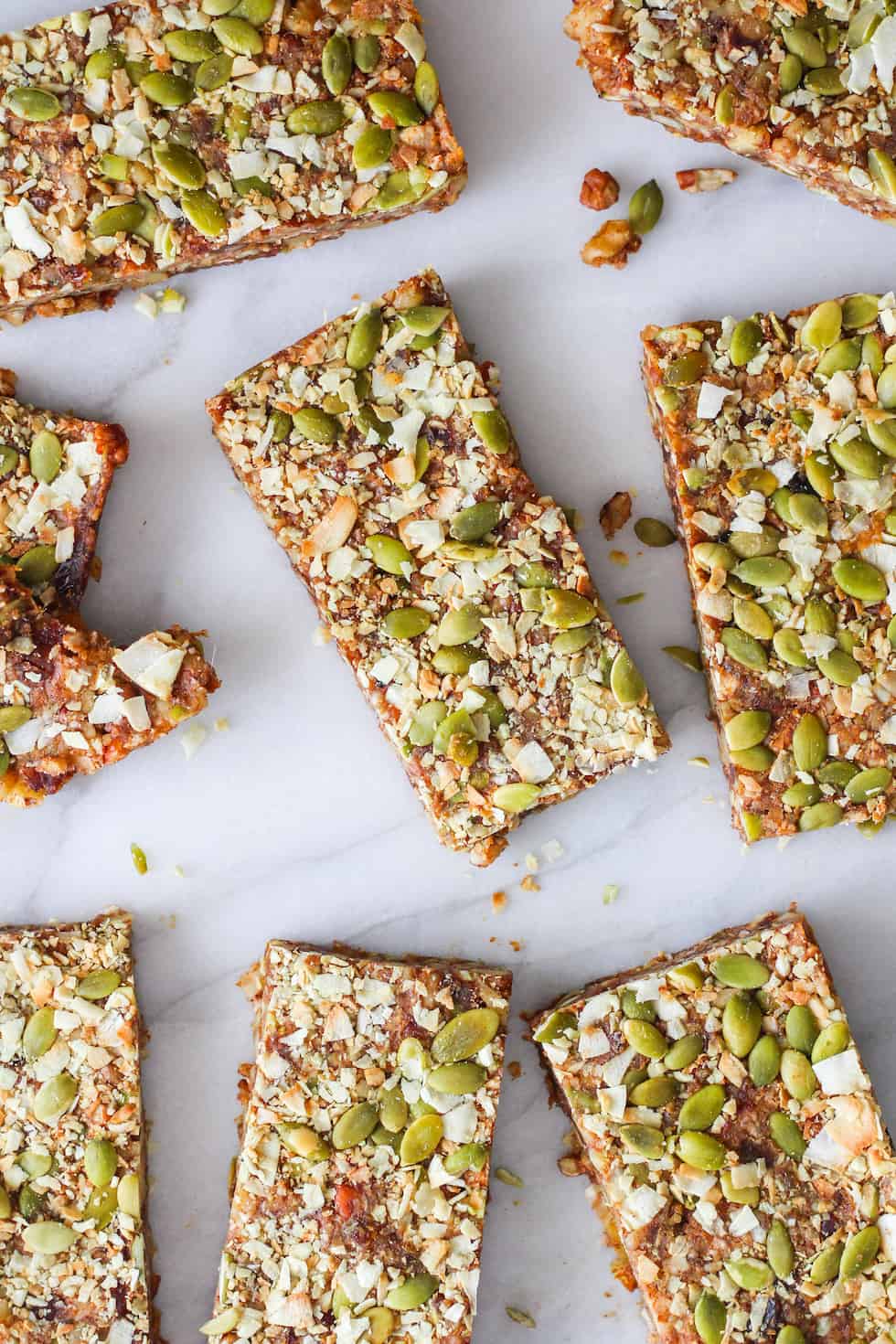
Prepping your own healthy snack is easy with this recipe for Homemade Sweet Potato Energy Bars. These no-bake bars are naturally vegan and have no added sugar. They’re great for an on-the-go breakfast, packable snack, or healthier dessert to always keep stocked in your freezer. You only need cooked sweet potato, dates, nuts, and few more simple pantry essentials!
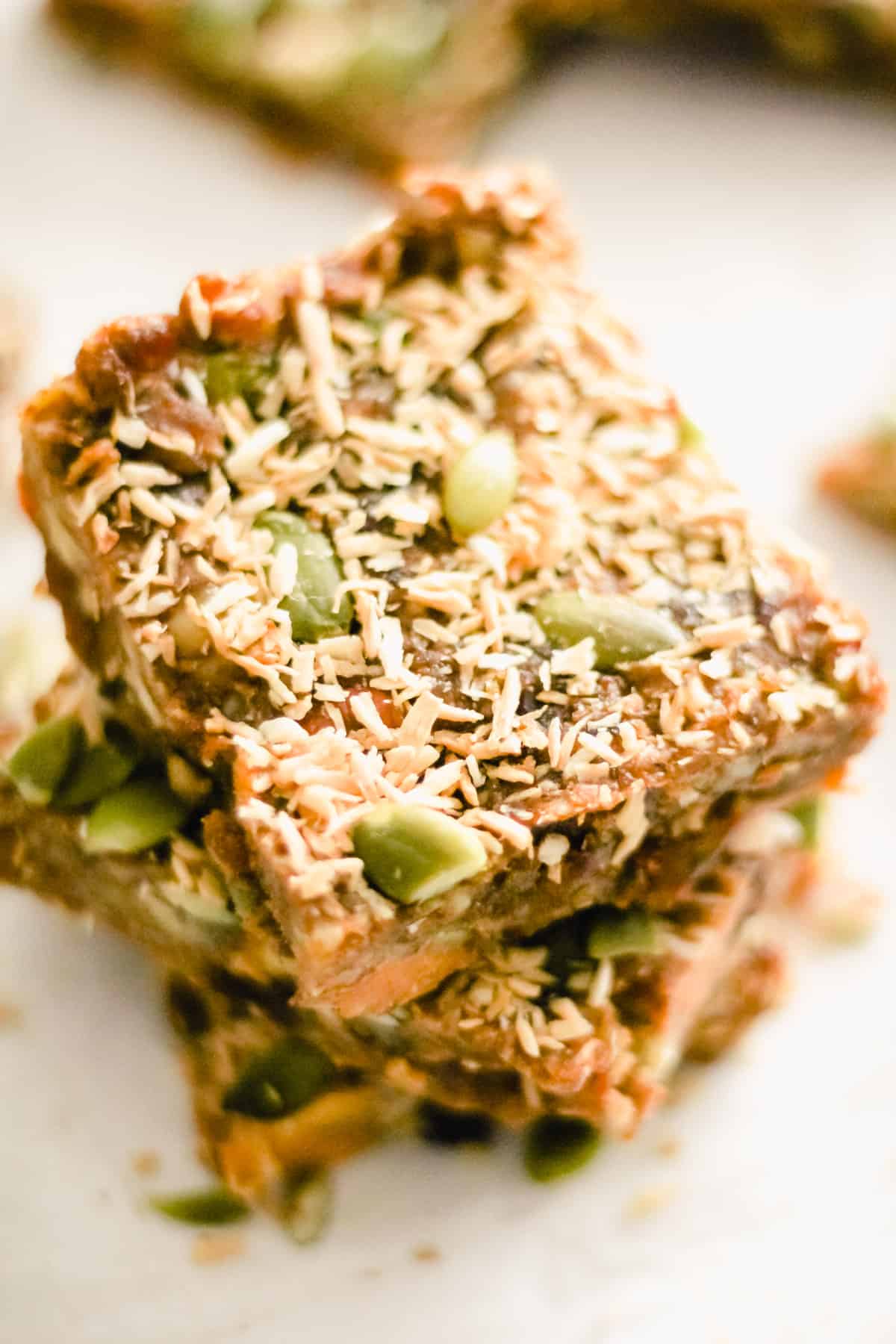
With sweet potato, cinnamon, vanilla, and pumpkin pie spice, these bars are obviously perfect for fall. But really, they’re delicious anytime of year.
I especially like to prep these anytime I have leftover cooked sweet potato in the fridge. There’s no cooking or baking required if you already have the sweet potato ready to go. (Roast up an extra one next time you make these 7-Ingredient BBQ Tempeh Loaded Sweet Potatoes. You won’t regret it.)
With a balanced mix of carbs, fat, protein, and fiber, these bars offer up a quick bite that’ll help you feel energized longer.
Grab a couple on your way out the door on a busy morning (so much better than skipping breakfast) or pack one in your bag for a mid-afternoon pick-me-up. They’re a tasty treat to enjoy whenever a dessert cravings strikes, too!
Jump to:
- Ingredients
- Preparation
- Instructions
- Substitutions
- Variation
- Equipment
- Storage
- Top tip
- Frequently Asked Questions (FAQ)
- Recipe
Ingredients
Along with the cooked sweet potato, you’ll just need a few basic pantry staples to make these homemade energy bars.
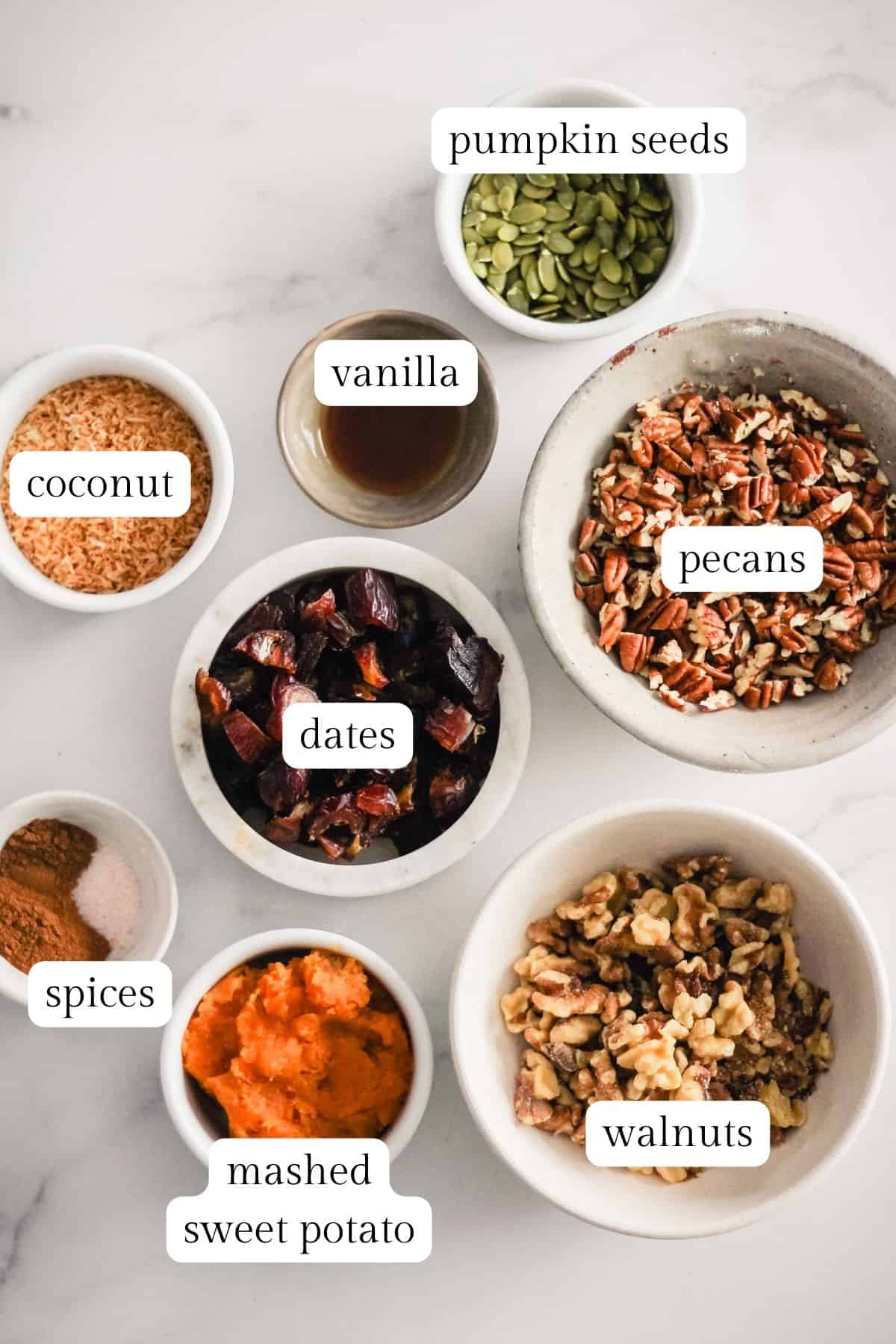
- Dates – You need pitted dates for this recipe, but I like to buy whole dates and remove the pits myself. (I think the whole dates have better texture!) Feel free to purchase pre-pitted dates for added convenience if you prefer.
- Pecans – You can buy them pre-chopped (AKA pecan pieces) or chop them yourself.
- Walnuts – Like with the pecans, it doesn’t matter if you buy chopped walnuts, walnut halves and pieces, or chop the nuts yourself.
- Pumpkin seeds – These are also called pepitas.
- Mashed sweet potato – I’m including instructions for how to cook mashed sweet potato below and in the recipe card at the end of the post.
- Coconut – You can use coconut flakes or shredded coconut. Just make sure to get it unsweetened.
- Spices (ground cinnamon and pumpkin pie spice) – If you don’t have pumpkin pie spice, you can make your own using a mix of ground cinnamon, ginger, nutmeg, cloves, and allspice. Try this Homemade Pumpkin Pie Spice recipe from Sally’s Baking Addiction.
- Vanilla extract – Use pure vanilla extract if possible.
See the recipe card at the end of the post for exact quantities.
Preparation
If you don’t have leftover cooked sweet potato, you’ll need to make some before you start this recipe. Optionally, you can also toast the coconut to bring out some extra flavor.
Here’s how to prep both ahead of time.
Mashed Sweet Potato
Stovetop method: Slice a sweet potato in half and transfer it to a pot. Add enough water to fully cover the sweet potato. Bring to a boil and cook for 25 minutes, or until the sweet potato is tender. (It should be very easy to pierce it with a fork.) Drain and allow the sweet potato to cool. Once it’s cool enough to handle, peel off the skin and use a potato masher or fork to mash until smooth.
Oven method: Preheat the oven to 450 degrees Fahrenheit. Pierce a sweet potato multiple times with a fork and place it directly on the center rack of the oven. Bake for 45 minutes, or until tender. (It should be very easy to pierce it with a fork.) Remove the sweet potato from the oven, allow it to cool. Once cool enough to handle, slice it in half, peel off the skin, and use a potato masher or fork to mash until smooth.
Toasted Coconut
I like to toast coconut in the oven for the best results.
Preheat the oven to 325 degrees Fahrenheit and spread coconut flakes or shredded coconut on a baking sheet. Bake for about 5 minutes, or until golden brown.
It’s important to watch this closely because the coconut can easily burn if it’s left for even a minute too long!
Instructions
Making your own energy bars is really simple. Here’s a basic summary of the steps. You can find more detailed instructions in the recipe card at the end of the post.
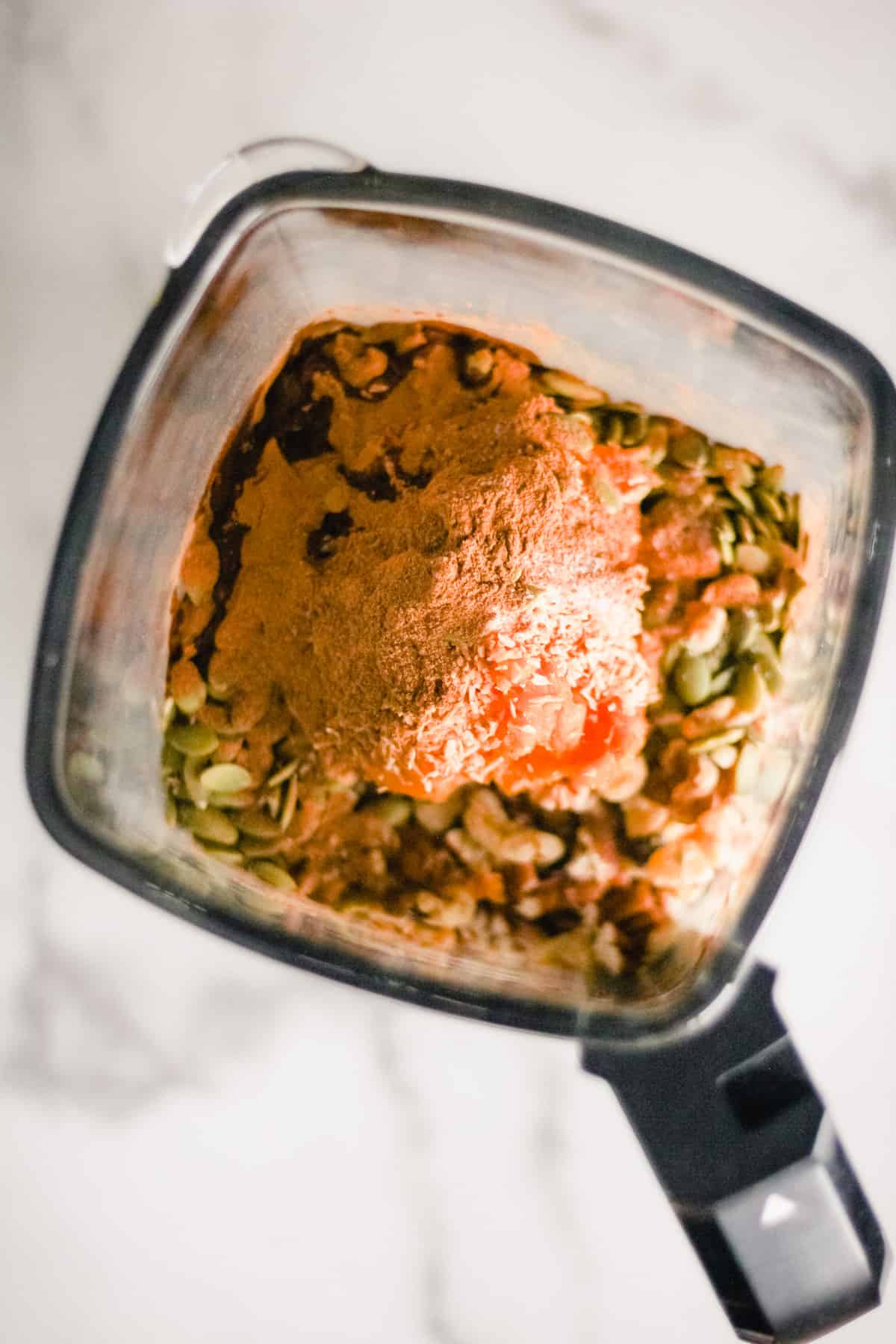
Add the ingredients to a food processor or blender and pulse until the mixture is broken up into small pieces. It should stick together when you press it between your fingers.
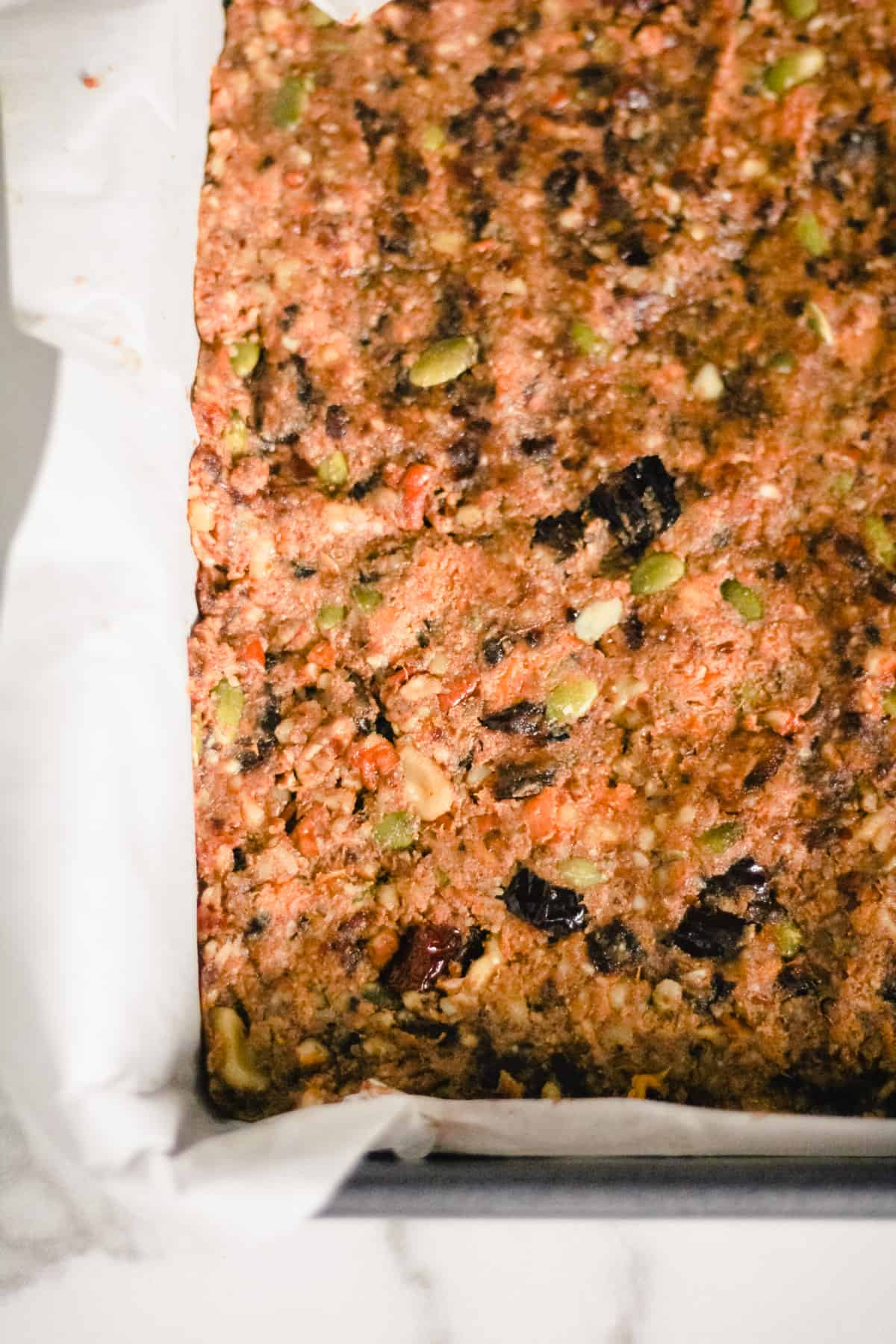
Transfer the mixture to a parchment-lined square baking dish. Press firmly so it sticks together.
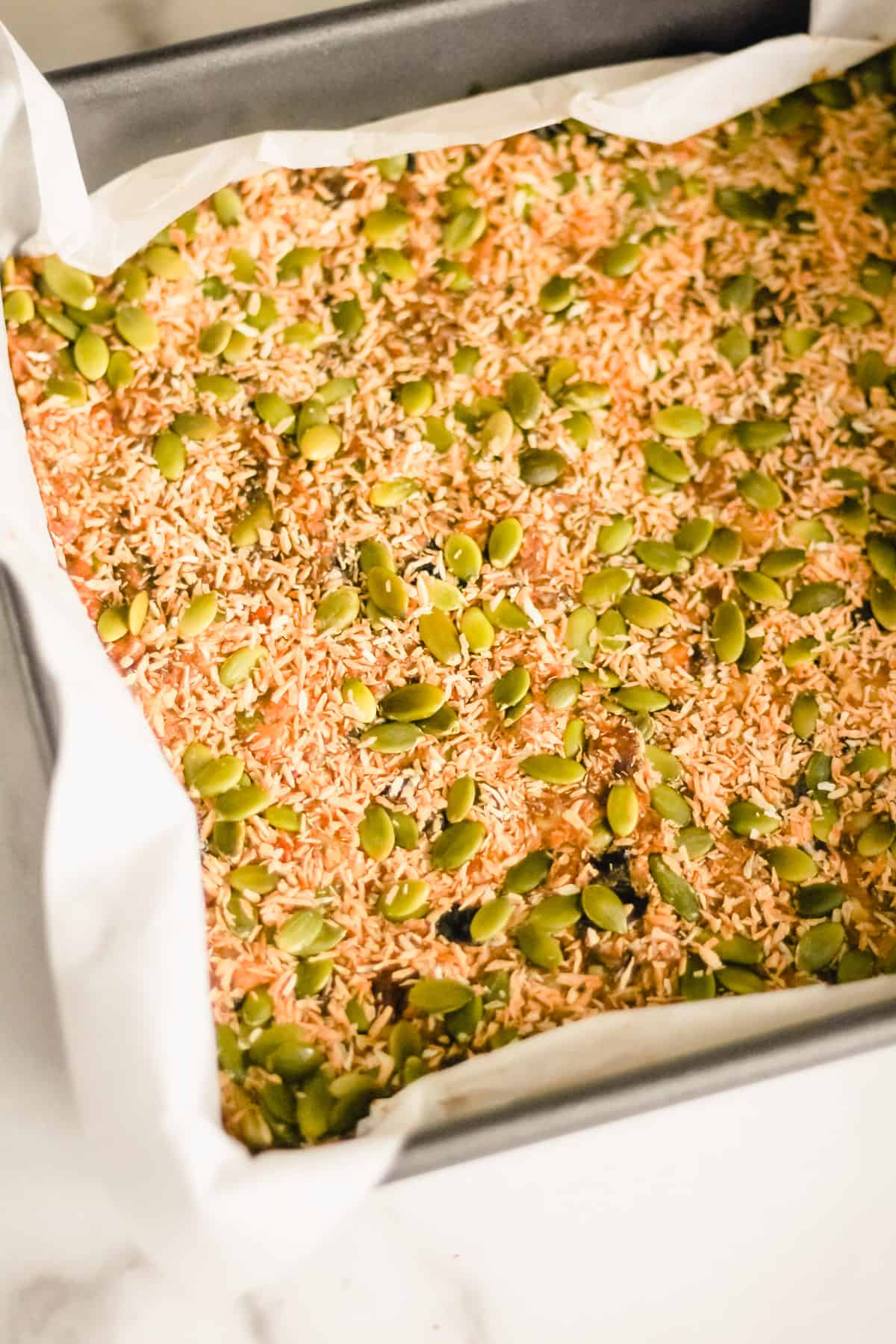
Add toppings (optional) and freeze for at least two hours.
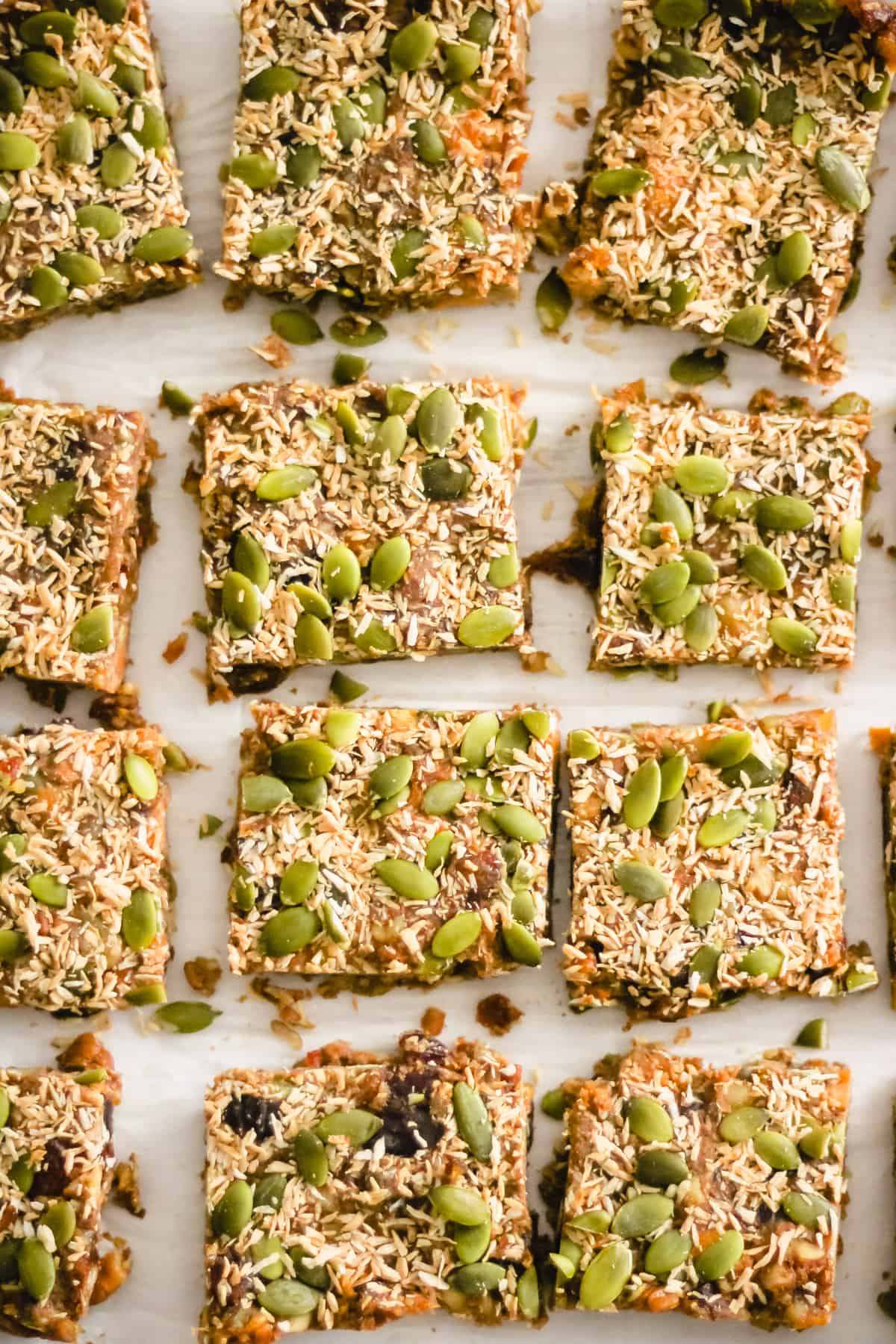
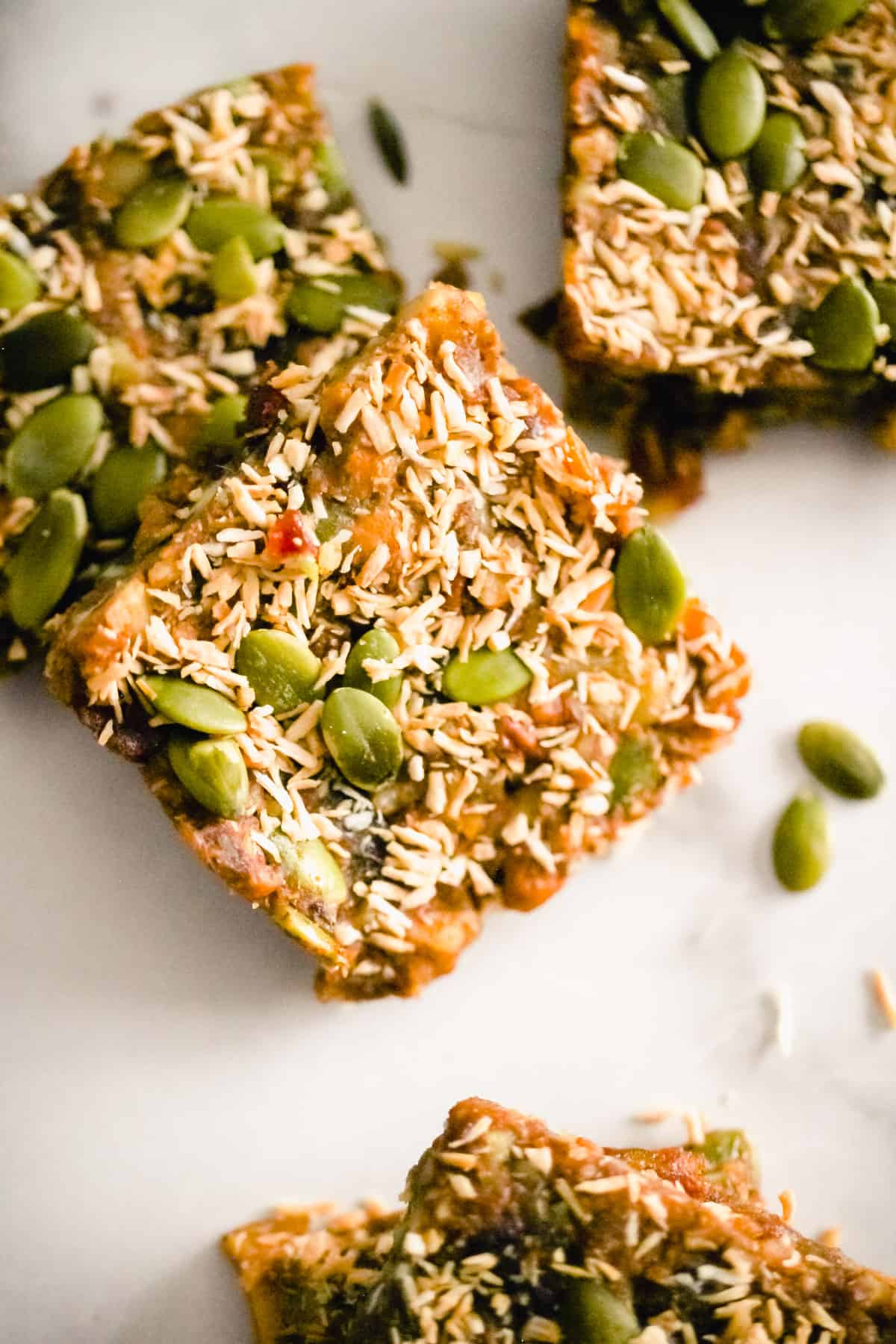
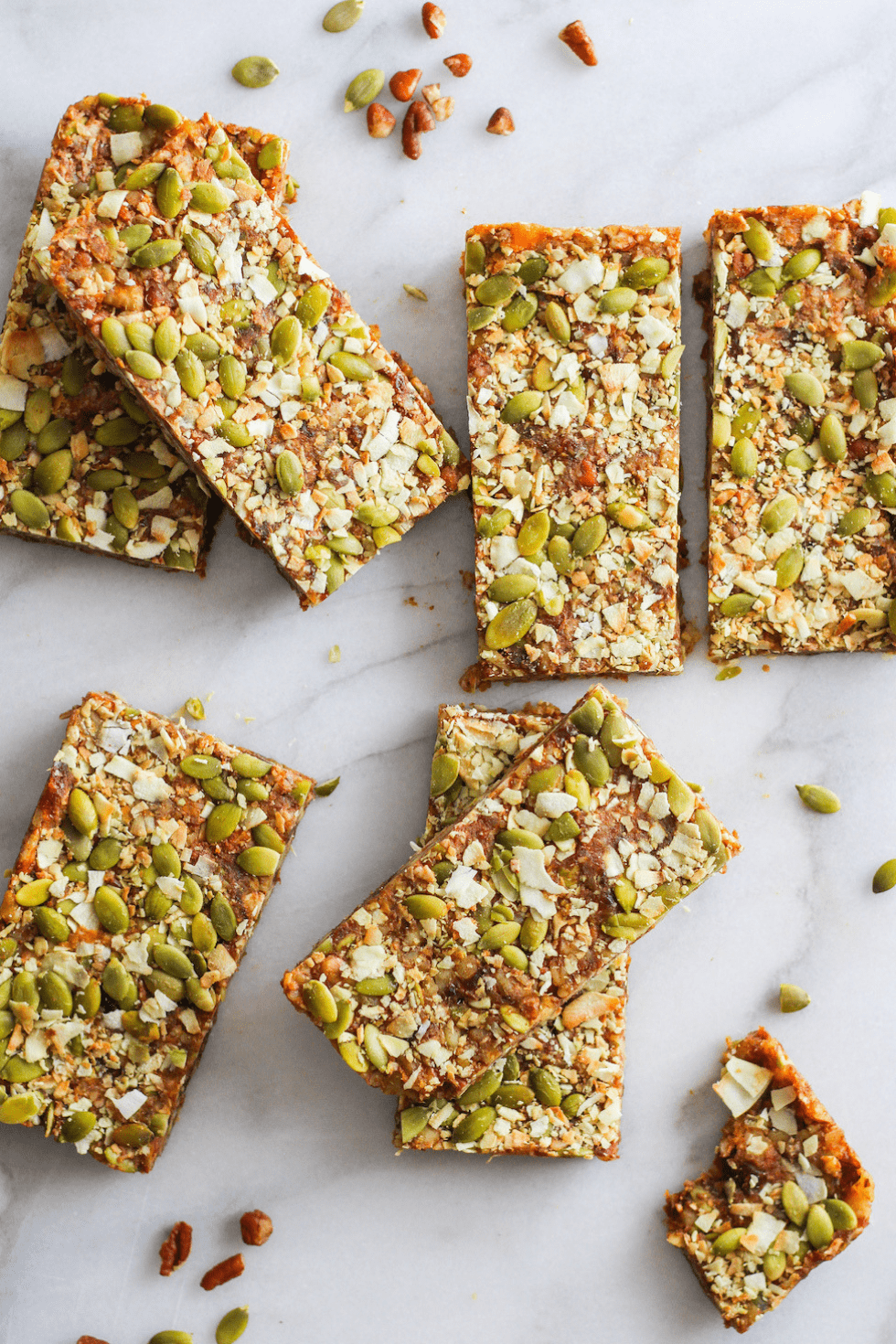
Slice into 8-16 pieces (depending on desired size) and enjoy!
Hint: For square-shaped bars, cut into 16 pieces. For larger, rectangular bars, you can slice into either 8 or 12 pieces.
Substitutions
- Pumpkin Pie Spice – If you don’t have pumpkin pie spice (and don’t want to make your own), just substitute an additional teaspoon of ground cinnamon.
- Nuts – The nuts in this recipe are interchangeable. So if you don’t have pecans, you can substitute additional walnuts (and vice versa).
Variation
- Pumpkin – use canned pumpkin puree or mashed winter squash instead of the sweet potato.
If you’re looking for more homemade bar recipes, try my Coconut Matcha Energy Bars and Easy No-Bake Sesame Date Bars!
Equipment
Food processor or blender: A full-size food processor works best for this recipe, but you can still make these bars with a blender if needed. (You’ll probably just need to pause more often to stir and scrape the edges of the container with a spatula.) If you only have a small food processor/chopper, stir together the ingredients in a mixing bowl and then process in batches as needed.
8×8-inch baking dish: A square baking dish acts as a mold for the bars to take on their shape.
Parchment paper: You could technically make these without, but parchment paper makes it a lot easier to remove the bars from the pan once they’re frozen. It also makes cleanup easier.
Storage
These energy bars stand up well to freezing, and you can store them in a freezer-safe bag or airtight container for up to six months.
If you don’t have access to a freezer, refrigerate the bars in an airtight container for up to five days.
I find that these bars hold their structure best when frozen, but they’ll still taste great if you store them in the fridge. I think they’re still easy to chew right out of the freezer!
Because they contain cooked sweet potato, you shouldn’t leave them at room temperature for more than two hours.
Top tip
If you use a blender to make these bars, you will probably need to pause to scrape the sides of the container with a spatula. It also helps to stir the mixture occasionally until it’s evenly blended.
Frequently Asked Questions (FAQ)
Homemade energy bars last up to six months if you store them in the freezer.
For long-lasting energy, look for energy bars with a mix of carbohydrates, fat, and protein. Nuts, seeds, and dates provide an energizing mix of nutrients.
Recipe
Sweet Potato Energy Bars
Pin
Save Saved!
Rate
Equipment
-
Food processor or blender (see note)
-
8 x 8-inch baking dish
-
Parchment paper
Ingredients
- 12 dates pitted and chopped
- 1 cup chopped pecans or pecan pieces
- 1 cup chopped walnuts or walnut halves and pieces
- ½ cup mashed sweet potato (see note)
- ¼ cup pumpkin seeds also called pepitas
- ¼ cup unsweetened shredded coconut or coconut flakes, toasted if desired (see note)
- 2 teaspoons ground cinnamon
- 1 teaspoon pumpkin pie spice
- 1 teaspoon vanilla extract
- ½ teaspoon salt
Optional toppings:
- 2 tablespoons pumpkin seeds (also called pepitas)
- 2 tablespoons unsweetened shredded coconut or coconut flakes, toasted if desired (see note)
Instructions
-
Add dates, pecans, walnuts, mashed sweet potato, pumpkin seeds, coconut, cinnamon, pumpkin pie spice, vanilla, and salt to a blender or food processor container. Pulse until the mixture is broken up into small pieces and sticks together when you press it between your fingers. You may need to pause to scrape the edges of the container with a spatula and stir the mixture for even blending.
-
Line an 8×8-inch baking pan with parchment paper. (This makes it easier to pull out the bars once they’re frozen.) Transfer the mixture to the pan and press firmly with your hands or a spatula to help the bars stick together.
-
Press additional pumpkin seeds and coconut flakes on top of the mixture if desired.
-
Cover and freeze for 2 hours, or until set.
-
Remove the pan from the freezer and pull out the parchment paper to remove the bars from the pan. Transfer the mixture to a cutting board and slice into 8, 12, or 16 pieces (depending on desired size).
Notes
Stovetop method: Slice sweet potato in half and transfer to a pot. Cover with water and bring to a boil. Boil for 25 minutes, or until the sweet potato is tender. (It should be very easy to pierce with a fork.) Drain and allow the sweet potato to cool. Once cool enough to handle, peel off the skin and use a potato masher or fork to mash until smooth.
Oven method: Preheat oven to 450 degrees Fahrenheit. Pierce sweet potato multiple times with a fork and place directly on the center rack of oven. Bake 45 minutes, or until tender. Remove sweet potato from oven, allow to cool, and slice in half. Once cool enough to handle, peel off the skin and use a potato masher or fork to mash until smooth.
To prepare toasted coconut:
Stovetop method: Add coconut to skillet and cook over medium heat, stirring often, 5 minutes, or until brown. Remove from heat immediately to avoid burning. Watch closely because the coconut can easily burn if left too long.
Oven method: Preheat the oven to 325 degrees Fahrenheit. Spread coconut on a lined baking sheet and transfer to the oven. Bake for 5 minutes, or until golden brown. Watch closely because the coconut can easily burn if left too long.
Blender/food processor note: A full size food processor works best for this recipe. If you use a blender, you will probably need to pause to scrape the sides of the container with a spatula. It also helps to stir the mixture occasionally until it’s evenly blended. If you only have a small food processor/chopper, stir together the ingredients in a mixing bowl and then process in batches as needed.
Storage: Store bars in a freezer-safe bag or airtight container for up to 6 months or refrigerate for up to 5 days. (I prefer to freeze them so they’re sturdier and last longer.)
Nutrition facts are estimates only and are based on a serving size of 1 bar after cutting the bars into 16 pieces.
Nutrition
Print Recipe
This is the best time of year to treat yourself to a strawberry yogurt parfait is layered with fresh berries, dairy-free yogurt, and crunchy chocolate chia seed granola.
(This post is sponsored by So Delicious®. As always, all opinions are my own.)

There is so much to love about this time of year, but I think the fresh strawberries are my favorite part. They’re a true harbinger of warmer days ahead and you just know spring is in full swing once strawberry season rolls around.
I recently picked up a load of fresh strawberries and used them to add sweet and tart fruity flavors to everything from breakfast to dessert. I’m be sharing a few of my favorite recipes in honor of the season here on the blog this week.
First off is this vegan Strawberry Yogurt Parfait, which is layered with a drool-worthy mix of fresh sliced berries, crunchy chocolate-flavored granola, and creamy, dairy-free yogurt. I love this parfait because it’s satisfying enough for breakfast, yet also decadent enough to have for dessert. A truly sweet start to Strawberry Week!

Health Benefits of Strawberries
Beyond flavor, there are many nutritional benefits of eating strawberries, too. They’re a great source of antioxidants, especially vitamin C. Strawberries also have fiber for a happy gut. Paired with rolled oats, almonds, chia seeds, and dairy-free yogurt, they make a balanced and energizing breakfast to start the day.

How to Make a Strawberry Yogurt Parfait:
The majority of the work you have to do to make this yogurt parfait recipe is related to the Chocolate Chia Seed Granola, and even that is pretty minimal. Just toss all of the ingredients in a bowl, spread the mixture on a baking sheet, and bake for about 25 minutes. Once the granola is baked, allow it to cool in the pan for a few minutes before breaking it into smaller pieces.

Tips for Making the Best Homemade Granola:
- Keep the oven temperature low (I set mine to 325º F) and check the granola near the end to prevent it from burning.
- If you prefer large clusters, don’t stir the granola at all while it bakes. If you want smaller pieces of crunchy granola, stir the mixture once or twice during the baking process.
- Don’t be concerned if the granola doesn’t seem as crunchy as you’d like while it’s in the oven. It will continue to get crispier as it cools.

Making your own granola is a great way to utilize pantry ingredients and avoid an extra shopping trip, but if you want to make this recipe really, really easy, store-bought granola also works fine.
Once you have the granola, there’s really only a little bit of assembly left to do. You’ll need a couple of glasses, ice cream dishes, or mason jars to hold the parfaits. Anything works, but ideally, choose containers made of clear glass, because all of the colorful layers of yogurt, berries, and granola really are the best part.

What type of yogurt is best for this recipe?
To make a vegan strawberry yogurt parfait, I like So Delicious® dairy-free yogurt alternative. For this recipe, I used their Strawberry Banana Coconutmilk flavor, but you could instead opt for vanilla, blueberry, raspberry, or any other type that sounds good to you. Besides all of the flavor options, I like that So Delicious® is part of Danone North America, which is a Certified B Corporation® working toward a more sustainable food system.

Can you make this strawberry yogurt parfait ahead of time? What’s the best way to store it?
Feel free to double the batch, since you can bake the chocolate granola for this recipe in advance. It’ll stay fresh in a cool, dry place for up to 6 months. Store it in an airtight container.
While you can easily prep the granola ahead of time, I recommend holding off on slicing the berries and assembling the parfait until right before serving. This ensures the best possible crunchy texture and fresh, fruity flavor. If you don’t mind if the granola loses some of its crunchiness, you can keep these parfaits fully prepared in the fridge for a few days.

Potential Ingredient Substitutions
- If you don’t have fresh strawberries, use thawed frozen berries or dried fruit. If you use dried fruit, cut the amount in half because they’re more concentrated.
- No oats or granola? Try cereal, broken cookies, or trail mix.
- If you’re out of cocoa powder, substitute a teaspoon of ground cinnamon. The flavor of the granola will be different but still taste great with strawberries.

Recipe

Strawberry Yogurt Parfait
Pin
Save Saved!
Rate
Equipment
-
Oven
-
rimmed baking sheet
Ingredients
Chocolate Chia Seed Granola:
- 1 cup old fashioned rolled oats (gluten-free if needed)
- ⅓ cup slivered almonds
- 2 tablespoons cocoa powder
- 1 tablespoon chia seeds
- ¼ teaspoon salt
- ¼ cup maple syrup
- 2 tablespoons almond butter or nut butter of choice
Strawberry Yogurt Parfaits:
- 2 (5.3-ounce) containers So Delicious Strawberry Banana Coconutmilk Yogurt Alternative
- 1 cup quartered strawberries
Instructions
Prepare the Chocolate Chia Seed Granola:
-
Preheat oven to 325 degrees Fahrenheit and line a rimmed baking sheet with a silicone baking mat or parchment paper.
-
Add oats, almonds, cocoa powder, chia seeds, and salt to a large mixing bowl and stir to combine. Stir in maple syrup and almond butter.
-
Spread the oat mixture on the prepared baking sheet and bake for 25 minutes, or until the oats begin to harden.
-
Cool granola on the baking sheet for at least 5 minutes. The granola will continue to crispen as it cools.
-
Once cooled, use your hands to break the granola into small pieces
Prepare the Strawberry Yogurt Parfaits:
-
Add a third of the So Delicious Yogurt Alternative to the bottom of two glasses. Add a third of the granola and a third of the strawberries. Repeat until all of the ingredients are used. You may have some leftover granola to save for another use.
-
For the crunchiest texture, serve immediately after you assemble the parfaits. If you don’t mind softer granola, tightly cover and refrigerate the prepared parfaits for up to 3 days. Store prepared granola in an airtight container in a cool, dry place for up to 6 months.
Notes
Looking for More Vegan Breakfast Recipes?
Try these:
- Blackberry Overnight Oats
- Lemon Oatmeal
- Mushroom Avocado Toast
- Mango Orange Smoothie
- Tempeh Bacon Sweet Potato Hash
Save this Vegan Strawberry Yogurt Parfait on Pinterest.


Did you Try This Recipe?
Rate and leave a comment below, or tag me (@GratefulGrazer) if you share on Instagram. I’d love to hear how it went!
]]>Print Recipe
No matter the meal, you can’t go wrong with this vegetarian frittata! Sautée mushrooms and spinach and mix with eggs and goat cheese to make a one-pan, beginner-friendly egg dish in just about 30 minutes.

If you’re looking for a sweet and savory breakfast combo, pair this frittata with my Overnight Mango Banana Chia Pudding with Coconut Milk. For something to drink, serve with a Vanilla Matcha Latte.
How to Make a Vegetarian Frittata with Mushrooms and Goat Cheese
Okay, let’s get back to this Mushroom Goat Cheese Frittata because it for sure deserves its own time to shine in the spotlight.
I love this vegetarian frittata recipe because you can cook it all in one skillet (just make sure it’s oven-safe), and it also only takes about 30 minutes from start to finish, which makes it super convenient for any meal, any day of the week.
I use mushrooms and frozen spinach in this recipe, but really, the great thing about frittatas is that anything goes! Use up leftover cooked veggies or other odds and ends that you don’t want to go to waste in the fridge. (I just read Italians sometimes use leftover pasta, and that’s 100% where I’m going with my next one!)

So, What’s a Frittata, Anyway?
A frittata is an egg dish that’s kind of like an open-faced omelet or a crustless quiche.
There are many similar egg dishes like this made all over the world. This version is my own interpretation inspired by the flavors of the Mediterranean and Italy.
Vegetarian Frittata Ingredients
Here’s what you’ll need to make a Mushroom Goat Cheese Frittata:
- Eggs (I use large for all of my recipes)
- Plain, unsweetened milk (dairy or dairy-free)
- Grapeseed oil (or any type of cooking oil)
- Vegetables: onion, garlic, mushrooms (I like a mix of crimini, shiitake, and oyster mushrooms), and fresh or frozen spinach leaves
- Crumbled goat cheese
- Flavorings: dried thyme, salt, pepper, and, optionally, fresh herbs and cherry tomatoes for serving

Equipment to Make a Vegetarian Frittata:
Equipment-wise, you’ll need an oven-safe skillet.
Mine is cast iron and has a diameter of 10 ½ inches. If you only have a 12-inch (or larger) skillet, I recommend using 8-12 eggs to fully cover the surface of the pan.
I’ve seen some recipes that cook a frittata entirely on the stovetop, but I’ve always baked mine to finish. So, you’ll also need both the stovetop burner and an oven to follow this frittata recipe.
1) The Prep Work
This entire recipe is ready in 30 minutes, prep, cook, and resting time included. The prep itself is really easy if you buy pre-sliced mushrooms.
You’ll also need to preheat oven to 400 degrees Fahrenheit. Before I heat up my skillet on the stovetop, I like to whisk the eggs and milk together so they’re ready to go when I need them.

2) Sauté Vegetables and Cook on the Stovetop
I start by cooking frittatas on the stovetop. Coat the inside of your skillet with oil and heat it up over medium heat.
Once the oil is shimmering, stir in diced onion and cook until it turns translucent. Stir in the sliced mushrooms, chopped garlic, dried thyme, and salt, and cook a few more minutes, until the mushrooms soften and darken in color. Next, stir in the spinach and cook until it’s thawed (if you’re using frozen greens) and starts to wilt.
Once the vegetables are sautéed, reduce the heat to low and pour the egg and milk mixture over the vegetables in the skillet. Then, stir in the crumbled goat cheese, and cook until the eggs just begin to set. For me, this took four minutes.

3) Bake Frittata in the Oven
Once the eggs begin to set, transfer the skillet to the oven and bake for 8-10 minutes, or until the center of the frittata is no longer jiggly when you shake the skillet. When you insert a knife into the center, you shouldn’t be able to find any raw egg on it. (If you do see raw egg, bake the frittata for another couple of minutes.)
Once the cooking is complete, remove the skillet from the oven and allow the frittata to rest for at least 5 minutes before slicing it into pieces and serving. To remove the frittata from the pan, you can either flip it over onto a dish or use a silicone spatula to transfer.

How to Serve a Vegetarian Frittata:
Top this Mushroom Goat Cheese Frittata with fresh herbs (I like basil and oregano), quartered cherry tomatoes, and, for a little spice, cracked pepper.
If you want to make it a full meal, try serving this frittata alongside an arugula salad with roasted breakfast potatoes and/or buttered sourdough toast. So good! No matter the time of day.
(Anyone else craving breakfast for dinner?)

Troubleshooting: Vegetarian Frittata Ingredient Substitutions
Frittatas are extremely versatile and customizable. Don’t be afraid to let your creative side take the lead while you’re making them!
Dairy-Free Alternative:
Here’s an idea for making a similar dish without any dairy.
Omit the goat cheese and use a cup of cooked chickpeas instead. The flavor will be less tangy but still nutrient-rich and satisfying. Canned chickpeas work great, just drain and rinse them first.
Other Substitution Ideas:
- Instead of goat cheese, use crumbled feta cheese or tofu feta
- Instead of mushrooms, use tomatoes, bell peppers, asparagus, or broccoli (or a mix of any sautéed veggies)
- Instead of spinach, use kale or swiss chard
- Instead of thyme, use basil, rosemary, or oregano

Can you Make a Vegetarian Frittata Ahead of Time? What’s the Best Way to Store It?
Allow the frittata to cool completely for storage. Then, cover and store it in the refrigerator for up to five days.


Recipe

Mushroom Goat Cheese Frittata
Pin
Save Saved!
Rate
Equipment
-
10 ½-inch oven-safe cast-iron skillet
-
Burner
-
Oven
Ingredients
Frittata:
- 6 large eggs
- ¼ cup unsweetened almond milk or any plain, unsweetened milk
- 2 tablespoons grapeseed oil or any cooking oil
- ½ cup diced onion
- 1 cup 4 ounces sliced mushrooms (such as a mixture of crimini, shiitake, and oyster mushrooms)
- 3 cloves garlic, chopped
- 1 teaspoon dried thyme
- 1 teaspoon coarse salt
- ½ cup spinach leaves (fresh or frozen)
- 1 cup 5 ounces crumbled goat cheese
Optional for Serving:
- Fresh herbs, such as basil and oregano leaves
- Cherry tomatoes, quartered
- Cracked pepper
Instructions
-
Preheat oven to 400 degrees Fahrenheit. Whisk eggs and almond milk together and set aside.
-
Pour grapeseed oil into a 10 ½-inch oven-safe cast-iron skillet over medium heat. Once the oil is shimmering, stir in onion and cook 4 minutes, or until translucent. Stir in mushrooms, garlic, thyme, and salt, and cook 4 additional minutes, or until mushrooms soften and darken in color. Stir in spinach and cook 3 minutes, or until thawed (if frozen) and wilted.
-
Reduce the heat to low and pour the egg and milk mixture over the vegetables in the skillet. Stir in crumbled goat cheese, and cook 4 minutes, or until the eggs just begin to set.
-
Transfer the skillet to the oven and bake 8 minutes or until the center is no longer jiggly. When you insert a knife into the center, you should not see any raw egg.
-
Once cooked, remove the skillet from the oven and allow the frittata to rest for at least 5 minutes before slicing it into pieces and serving. To remove the frittata from the pan, you can either flip it over onto a dish or use a silicone spatula to transfer. Serve with fresh herbs, cherry tomatoes, and cracked pepper if desired.
-
Allow the frittata to cool completely for storage. Then, cover and store it in the refrigerator for up to five days.
Notes
Looking for More Vegetarian Breakfast Recipes?
Try these:
- Strawberry Banana Baked Oatmeal
- Whole Wheat Lemon Blueberry Muffins
- Mushroom Bean Avocado Toast
- Vegan Lemon Oatmeal
Save this Mushroom Goat Cheese Frittata Recipe on Pinterest.

Did you Try This Mushroom Goat Cheese Frittata Recipe?
Rate the recipe and leave a comment below, or tag me (@GratefulGrazer) if you share a photo on Instagram. I’d love to hear how it went!
]]>Print Recipe
This easy Overnight Mango Banana Chia Pudding with Coconut Milk is a healthy and delicious meal prep breakfast without dairy or added sugar. Best part: you only need 6 simple ingredients to make it! Simply layer vanilla coconut chia seed pudding and fruit puree in a jar. Then, top with fresh mango and toasted coconut for a portable morning meal with refreshing tropical flavors.

I love chia pudding for busy weekdays. It works especially well when you need a breakfast you can quickly grab on your way out the door. (I have lots of ideas for vegetarian work lunches to have later in the day here, too!)
The tropical vibes in this recipe would also be great for a spring or summer brunch. (Think Easter or Mother’s Day!)
Pair it with avocado toast or a vegetarian frittata if you’re looking for a sweet and savory combo. For something to drink, add a Vanilla Matcha Latte.
Jump to:
- What does chia pudding taste like?
- Overnight Oats vs. Chia Pudding
- Ingredients
- Instructions
- Substitutions
- Variations
- Nutrition
- Equipment
- Storage
- Top tip
- Frequently Asked Questions (FAQs)
- Recipe
- Food safety
- Meal Prep Ebook
What does chia pudding taste like?
Chia pudding has a creamy texture that’s a little bit lumpy (kind of like tapioca). The primary flavors depend on the type of milk used, as well as any add-ins, such as fruit, chocolate, coconut, and nuts or nut butters.
This particular recipe tastes like coconut, vanilla, and tropical fruit. It’s refreshing and so delicious!
Overnight Oats vs. Chia Pudding
Overnight oats and chia pudding are similar. They’re both cold, meal prep breakfasts that are convenient for busy mornings. Both use milk and often feature fruit or other toppings.
The main difference is that soaked rolled oats form the base of overnight oats, while chia pudding is made by soaking chia seeds. Both of these foods take in moisture from milk and soften as they sit in the fridge overnight.
Try my Blackberry Overnight Oats recipe if you want to compare them both!
Ingredients
You only need a few simple ingredients to make this recipe.

- Chia seeds
- Coconut milk (unsweetened)
- Mango
- Banana (preferably ripe)
- Vanilla extract (optional)
- Shredded coconut (optional)
See recipe card for quantities, and check out my Vegetarian Grocery List and Shopping Tips before you head to the store!
Instructions
To make this recipe, first mix together the chia pudding. Then, blend the fruit puree. Once the pudding is set, assemble the jars and add optional toppings if you’d like.
Chia Seed to Coconut Milk Ratio
I use a 1:4 ratio of chia seeds to coconut milk for my chia pudding. This equates to 2 tablespoons of chia seeds for every ½ cup of coconut milk in one serving.
To make it, stir chia seeds, coconut milk, and vanilla extract (if using) in a container that has a lid. (If you don’t have a container with a lid, use a bowl and cover with plastic wrap or reusable beeswax wrap.)
Cover and refrigerate the mixture overnight, or until the it’s set. Chia pudding typically takes about four hours to fully set. So, you can also prep it in the morning and then assemble the jars later on in the same day if you want.

Mango Banana Puree
In the meantime, prepare the fruit puree.
Add diced mango (chopped into small pieces) and banana to a blender or food processor. Blend or process on high for 30 seconds, or until smooth.
Transfer to a container with a lid, cover, and refrigerate. (Again, use a bowl covered in plastic wrap if you don’t have a container with a lid.)

Hint: To dice a mango, slice vertically, about a quarter-inch from the center on each side. Then, cut the flesh into a grid pattern without going through the skin. Use a spoon to scoop out the flesh. Find detailed instructions for how to cut a mango here.
You can use frozen mango chunks instead of fresh mango if you want. Just thaw the fruit overnight in the fridge first.
The next day (or at least four hours later), the chia pudding should be creamy and not runny. It will look something like this:

Toppings
I like to top this Banana Mango Chia Pudding with more diced mango and some shredded coconut. This step is totally optional, but adds some extra flavor, texture, and visual appeal.
How to Toast Shredded Coconut in the Oven
To toast shredded coconut, preheat the oven to 350ºF and prepare a baking sheet. (I like to line it with parchment paper for easy cleanup.)
Spread shredded coconut on the baking sheet and bake for 3 minutes, or until golden brown. (You may need to bake a couple of minutes longer for large shreds or coconut flakes.)

Serving
This recipe makes two portions, which I like to serve in 8-ounce jars. (It’s nice to be able to see the layers of fruit and chia pudding, and the jars are also portable so you can easily take them to go.)
Of course, you can also serve this in a bowl if you want.
To assemble, first spoon a quarter of the fruit puree into the bottom of a jar. Then, add half of the chia pudding on top. Add another quarter of the fruit puree and your toppings (if using).
Then, repeat with the remaining ingredients to assemble the second jar.

Substitutions
This recipe is naturally vegan, dairy-free, soy-free, and gluten-free. Feel free to make any of the following substitutions depending on your preferences or the ingredients in your kitchen.
- Milk – Instead of coconut milk, you can substitute any type of milk you like
- Fruit – use thawed frozen fruit instead of fresh fruit if desired. You can also substitute pureed baby food for the fruit if you’re making this for your little one.
- Vanilla – use a vanilla-flavored coconut milk if you don’t have any vanilla
- Without Coconut – substitute another type of milk (such as oat milk), and omit the shredded coconut, or top with chopped nuts instead
Variations
Want to change up the flavor profile of this recipe? Here are some ideas.
- Chili-lime – add chili powder and lime juice to the fruit puree for Mexican-inspired flavor
- Peach-mango – use peach instead of banana
- Baby friendly – omit the toppings for babies who have just recently started solids. You can also use breast milk, formula, or whole milk instead of coconut milk. (Learn more about serving coconut milk to babies here.)
- More topping ideas – use berries, cacao nibs or chocolate chips, yogurt, nut butter, or chopped nuts.
Nutrition
Wondering if chia pudding is healthy? Chia seeds contain fiber, essential omega-3 fatty acids, and protein. Paired with fruit and your favorite milk, it makes a balanced and nutrient-dense breakfast, dessert, or snack.

Equipment
You’ll need a blender or small food processor to make the fruit puree for this recipe.
I didn’t have any trouble blending the mango and banana into a smooth puree with my blender. If it isn’t blending well for you, try adding a tablespoon of coconut milk to get the mixture going. You may also need to pause to scrape down the sides of the container with a spatula.
If you don’t have a blender or food processor, you can just add diced mango and sliced banana to the jars instead of the puree. This is also a great option if you want to make the prep work a little bit easier!
Storage
Store prepared chia pudding in jars with lids in the refrigerator for up to five days.
I’ve also read that you can freeze chia pudding, but I haven’t tried this myself. If you want to give it a go, transfer to a freezer-safe bag or container and freeze for up to three months.
Top tip
I use dairy-free coconut milk alternative for this recipe, which is typically sold in a box or carton. This coconut milk alternative tends to be thinner and lighter than canned coconut milk. Feel free to swap in canned, full-fat coconut milk if you want your chia pudding to be extra thick and creamy.
Frequently Asked Questions (FAQs)
Use a 1:4 ratio of chia seeds to milk, or 2 tablespoons for every ½ cup of milk.
Chia pudding usually takes about 4 hours to fully set. You can prep it the night before and leave it in the refrigerator to set overnight.
Chia pudding may be runny if you did not wait long enough for it to fully set. You also may have used too much liquid or not enough chia seeds. Try stirring in another tablespoon of chia seeds and allowing the mixture to set for longer in the fridge.
Milk (dairy or dairy-free) gives chia pudding its white color and creamy texture. Chia seeds will soften and thicken when mixed with water, but the result won’t be as creamy. Mixing chia seeds with thin yogurt or kefir will create a thick and creamy result.
Recipe

Overnight Mango Banana Chia Pudding with Coconut Milk
Pin
Save Saved!
Rate
Equipment
-
Knife and cutting board
-
blender or food processor
-
2 containers or jars with lids (for preparation)
-
2 (8-ounce) jars with lids (for serving)
-
Baking sheet (optional for toasted coconut)
-
Oven (optional for toasted coconut)
Ingredients
- ¼ cup chia seeds
- 1 cup coconut milk (dairy-free milk alternative)
- 1 teaspoon vanilla extract (optional)
- 1 cup diced mango (see note)
- 1 large banana, preferably ripe (see note)
Optional toppings:
- Diced mango or any fresh fruit
- Unsweetened shredded coconut, toasted if desired (see note)
Instructions
-
Stir chia seeds, coconut milk, and vanilla extract (if using) in a container with a lid. Cover and refrigerate overnight (or for at least 4 hours), or until the chia pudding is fully set. The mixture should be creamy and not runny.
-
In the meantime, add mango and banana to a blender or food processor. Blend or process on high for 30 seconds, or until smooth. Transfer to a container with a lid, cover, and refrigerate overnight, or until the chia pudding is set.
-
Once the chia pudding is set, assemble the jars. Add ¼ of the fruit puree to the bottom of an 8-ounce glass jar. Top with ½ of the chia pudding and another ¼ of the fruit puree. Top with diced mango and coconut if desired. Repeat with the remaining ingredients to assemble the second jar.
Notes
Banana note: Ripe bananas are soft and sweet, but a banana that is less ripe will also work fine.
Coconut note: To toast shredded coconut, preheat the oven to 350 degrees Fahrenheit and prepare a baking sheet. (I like to line the baking sheet with parchment paper for easy cleanup.) Spread shredded coconut in a single layer on the baking sheet. Bake for 3 minutes, or until golden brown. (You may need to bake a couple of minutes longer for large shreds or coconut flakes.)
Meal prep: Prepare this recipe up to 5 days in advance.
Storage: Store prepared Mango Banana Chia Pudding in jars with lids in the refrigerator for up to five days.
Nutrition
Food safety
Here are a couple of food safety tips to keep in mind for this recipe.
- Don’t leave food sitting out at room temperature for extended periods. Make sure you allow the chia mixture to set in the refrigerator.
- Cover the chia mixture and fruit puree while they are in the fridge to prevent contamination.
Meal Prep Ebook
Find more make-ahead tips and recipes in my ebook, Easy Vegetarian Meal Prep.
]]>Print Recipe

By posting this recipe I’m entering a recipe contest sponsored by the Wild Blueberry Association of North America and I’m eligible to win prizes associated with the contest. I was not compensated for my time.
I was pretty excited when Kara and The Wild Blueberry Association of North America invited me to participate in their smoothie contest.
Think regular cultivated blueberries – only better. (I know, it’s hard to imagine something better than regular blueberries but I swear to you, it’s real and it’s delicious.)
Wild blueberries have more intense blueberry flavor and double the antioxidants of cultivated blueberries. (Tastier + more nutritious = no-brainer.)
But another thing that my nerdy self loves about wild blueberries is that they really are wild.
Wild blueberries have been around for more than 10,000 years, growing naturally in fields called barrens in Maine and Eastern Canada. The plants naturally intertwine and spread across fields, creating berries that are more genetically diverse than the cultivated variety.
This genetic diversity is what gives wild blueberries there awesomely intense and complex flavor – with just the perfect balance of sweet and tart.

That intense flavor – locked inside because they’re frozen immediately at harvest – leads me to believe that wild blueberries are just screaming to be included in a bright, colorful, antioxidant-rich fruit smoothie.
The first task was to find additional ingredients that could complement the awesomeness of wild blueberries.
I ended up going with blood orange (in season now, yay!) and fresh ginger and let me tell you, the result is something so refreshingly sweet and tart and spicy.
You will want this smoothie in your life every. single. day.
Warning: this recipe serves two…if the smoothie chef doesn’t devour the entire thing before getting to the serving part. (Whoops.)
Of course, I can’t make a smoothie without including a rocking source of plant-based protein. This time, I went with soft tofu. It’s the perfect smoothie add-in because it doesn’t have a lot of flavor on it’s own but adds so much creaminess to the overall result. (To make this smoothie soy-free, sub with hemp/chia seeds and/or your favorite protein powder.)
I also tossed in some ground flax for even more protein and some fiber + healthy omega 3’s.
If I’m going to drink a smoothie for two – by myself – it’s going to at least contain a balanced amount of healthy carbohydrates/fiber, fats, and protein.

You’ll get:
- Intensely delicious and creamy wild blueberry + citrus flavor.
- Double the antioxidants of cultivated blueberries, which may offer benefits for cancer, gut health, diabetes, and brain health.
- Immune-boosting vitamin C from wild blueberries and blood orange.
- Potential anti-nausea benefits from ginger (especially for morning sickness + chemo-induced nausea.)
- A smoothie that qualifies as a balanced meal, with healthy carbohydrates, fiber, protein, and healthy fats.
- A smoothie so good that you might be unable and/or unwilling to share with your husband. (Or maybe that’s just me?)

You can find wild blueberries in the frozen section of your grocery store, just make sure the label says “wild!”
Recipe

Wild Blueberry + Blood Orange Smoothie with Ginger
Pin
Save Saved!
Rate
Ingredients
- 2 cups frozen Wild Blueberries plus additional for topping if desired
- zest and juice of 1 blood orange substitute with ¼ cup orange juice if you can’t find blood orange
- ½ teaspoon fresh grated ginger
- 2 tablespoon ground flax
- ½ block about 7oz silken or soft tofu
- 1.25 cups unsweetened coconut milk substitute with milk of choice
Instructions
-
Add ingredients to blender and blend on high until smooth. Add additional milk if needed to reach desired consistency. Transfer to glasses and top with additional wild blueberries if desired.
[Tweet “#WildYourSmoothie with this Wild Blueberry, Blood Orange + Ginger combo from @gratefulgrazer.”]
]]>Print Recipe
Golden milk in baked-good form! These gluten-free muffins are easy to bake yet packed with healthy nutrients and spicy flavors from turmeric and cinnamon. (Sponsored by Simple Mills.)

I love to eat baked goods, but I’m not always in the mood to make them from scratch. Sometimes I want to pop something warm and cozy in the oven and just know it’s going to turn out right. Know what I mean?
Since I spotted Simple Mills baking mixes at Target, I’ve been using them as a foundation for quick and easy muffin and cake recipes. These mixes aren’t just good for being gluten-free. They’re good, period. No qualifiers needed.

Now if you know me at all, you’ve probably already guessed that I couldn’t just follow the directions on the box and leave it at that. Since the basic mix was already done for me, I had ample energy left for adding in nuts, seeds, fruit, and warming spices to boost up the flavor (and health benefits) of these gluten-free muffins.
My inspiration is golden milk, a creamy drink made with coconut milk, turmeric, cinnamon, and ginger. These spices are already anti-inflammatory, but I decided to step it up a notch by also adding walnuts, walnut oil, and ground flax—some of the richest sources of plant-based omega-3s out there.


The nice thing about using a baking mix is that you can keep your recipe simple or toss in extras to fit your mood. Fold in walnuts and raisins for texture. Add ground flax for a little more protein. Or don’t—the exact formula is entirely up to you.
The perfect blend of quick, easy and creative!

Recipe

Gluten-Free Golden Milk Muffins
Pin
Save Saved!
Rate
Ingredients
- 2 large eggs
- 1 cup coconut milk (or water, see note)
- 2 tablespoons walnut oil (or melted coconut oil or vegetable oil)
- 1 box Simple Mills Banana Muffin & Bread Almond Flour Mix (9 ounces)
- 1 tablespoon ground flax (optional)
- 2 teaspoons ground turmeric
- 1 teaspoon ground cinnamon
- ½ teaspoon ground ginger
- ¼ teaspoon black pepper
- ½ cup chopped walnuts (optional, reserve some for topping if desired)
- ¼ cup raisins (optional)
Instructions
-
Preheat oven to 350 degrees Fahrenheit.
-
Whisk eggs, coconut milk, and oil in a large bowl. Stir in Banana Muffin Mix, ground flax (if using), turmeric, cinnamon, ginger, and black pepper. Fold in walnuts (reserve 1-2 tablespoons for topping if desired) and raisins (if using) and stir until well blended.
-
Pour batter into a lightly greased or paper-lined muffin tin, filling each cup about ⅔ full. Top with remaining chopped walnuts if desired.
-
Bake 25 minutes, or until an inserted toothpick comes out clean. Cool in the pan 5 minutes before transferring to a wire rack to cool completely.
Notes
Store muffins in the fridge or freezer.
Find Simple Mills baking mixes at a Target near you!
]]>Print Recipe

Today’s recipe contains an over-the-top amount of super-healthy ‘superfoods’.
Sometimes, I just can’t help it.
Plus, this month’s Recipe Redux theme is all about trying a new ingredient. And I’ve been dying to add some blue-green algae to my repertoire.
(I mean, really, who isn’t?) 

FIRST, A NOTE ON “SUPERFOODS”:
When people use the term ‘superfood’, they’re usually referring to powders, exotic ingredients, etc, and this is generally how I use the term here on TGG…
…But, I want to emphasize that nutrient density – having a lot of nutrition packed into a small package – is what makes a superfood impressive – not it’s exoticness/trendiness/price.
In reality, broccoli is just as much a superfood as spirulina.
I use superfoods (the slightly exotic, often powdered ones) in some of my recipes because I think trying something new and different makes healthy eating a lot more fun.
An important note, though, because I wouldn’t want anyone to feel as if superfoods are essential for a healthy diet. (I’d pretty much always recommend skipping the superfoods and opting for more fresh fruits and veggies when on a budget.)

Okay, back to the algae bites.
If the thought of algae bites doesn’t sound entirely appealing, you’ll be relieved to know that the spirulina is pretty well disguised in this recipe. With cacao nibs, dates, coconut, and goji berries, you won’t taste the spirulina too much.
Great for the algae novice.

Why spirulina?
Spirulina is a blue-green algae that is grown and harvested in water. It’s usually dried after harvesting and available as a powder or capsule/tablet – I used a powder for this recipe.
Spirulina contains a large amount of plant-based protein (more than 50% of spirulina is protein!) and also provides iron. It also contains essential omega 3 and 6 fatty acids (healthy fats), beta carotene, vitamin E, and vitamin B12.
(Note: the type of B12 in spirulina isn’t as bioavailable as the type that comes from animals, so don’t count on it to meet all of your needs if you’re vegan.)
We have scientific evidence that spirulina has antioxidant and anti-inflammatory benefits. It may also help decrease blood lipid levels, protect the liver, prevent muscle damage from exercise, support the immune system, and protect against some cancers.

Try these bites whenever you’re in need of a convenient and transportable snack that offers long-lasting energy.
Ready to get your algae on?


Recipe

Spirulina Superfood Bites
Pin
Save Saved!
Rate
Ingredients
- 3 tablespoon cacao nibs or cocoa powder
- 1 ⅓ cups dates pitted and chopped
- ½ cup cashews
- ½ cup almonds
- ⅓ cup goji berries
- 1 tablespoon spirulina powder
- 2 tablespoon chia seeds
- 1 tablespoon maca powder optional
- 2 tablespoon shredded coconut plus additional for rolling if desired
- Salt
Instructions
-
Add cacao nibs to food processor and process until coarse powder is formed. Spoon out ~1 tablespoon to roll balls in if desired and set aside.
-
Add remaining ingredients to food processor and process until broken down. Mixture should stick together when pressed between fingers. If mixture is crumbling, add a couple more dates and process again.
-
Spoon out ~2 tablespoon of the mixture and press and roll into a ball with hands. Repeat until mixture is completely used. Roll some of the balls in extra cacao and/or coconut if desired.
-
Refrigerate for at least 30 minutes before eating.
Notes

[Tweet “Get your algae on with these Spirulina Superfood Bites from @gratefulgrazer”]